Faculty-guided projects give emerging researchers experience investigating and communicating scientific questions
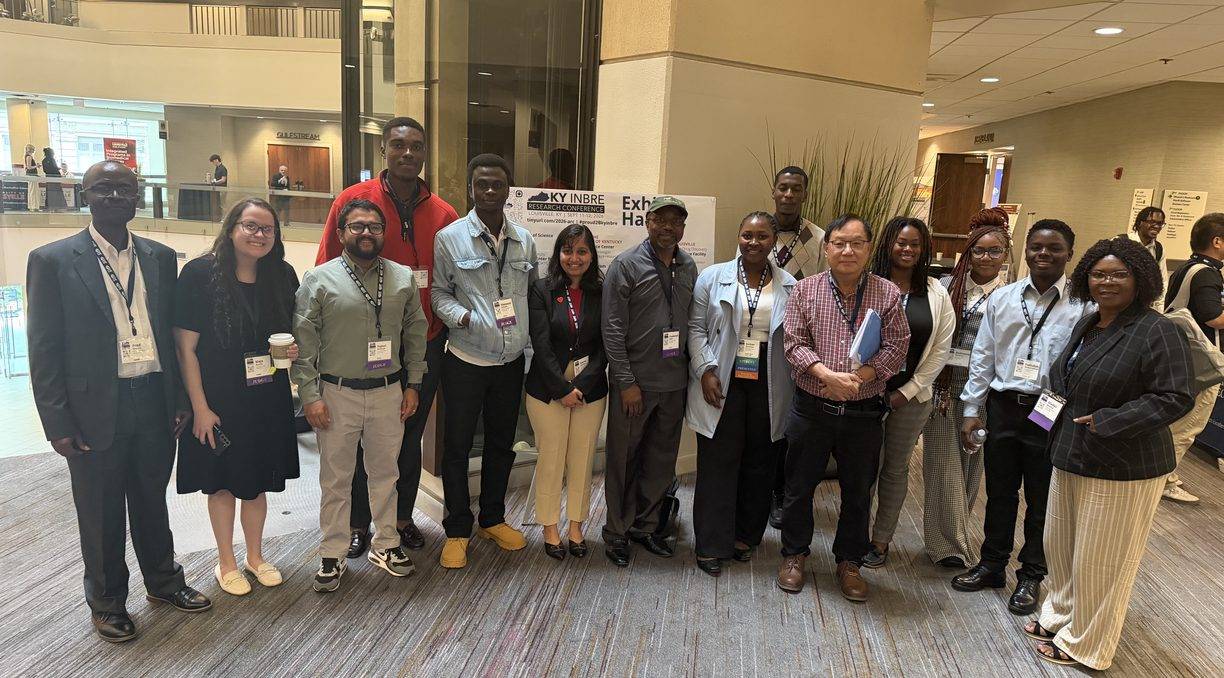
FRANKFORT, Ky. — Three Kentucky State University students carried faculty-guided research beyond the laboratory Sept. 11–12, presenting projects on influenza and reproductive science at the Kentucky IDeA Networks of Biomedical Research Excellence (KY INBRE) Annual Research Conference in Louisville.
DaiDreona Barbour and Jyni Woodson, biology majors in the Class of 2027, presented an ongoing study of influenza disease burden, vaccine mismatch, and viral mutations. Esther Oduntan, who will graduate in December 2026 with a Master of Science in Environmental Studies, presented research examining how different forms of selenium may affect early pregnancy in beef heifers.
 Their participation reflects how Kentucky State students engage in advanced research
as part of their learning experience, working alongside faculty members on collaborative
projects and sharing their findings with the broader scientific community.
Their participation reflects how Kentucky State students engage in advanced research
as part of their learning experience, working alongside faculty members on collaborative
projects and sharing their findings with the broader scientific community.
The third annual KY INBRE conference brought together more than 350 researchers, students, and exhibitors at the Hyatt Regency Louisville. Through poster sessions and research talks, participants gained experience explaining their work, responding to questions, and connecting with scientists from across the region.
Barbour and Woodson’s project compares the influenza strains selected for seasonal vaccines with those that ultimately became predominant. Their research draws on data from the United States, Canada, Europe, China, and Australia to examine how vaccine coverage, vaccine mismatch, and changes in the virus may influence hospitalizations and other severe outcomes.
The long-term project also seeks to identify viral mutations that may be associated with greater clinical severity. Barbour and Woodson conducted the research under the mentorship of Dr. Alexander Lai, associate professor of biology and a lead Kentucky State faculty representative to KY INBRE. Dr. Lai’s team also includes three other students: Jamal Hayes, Theresa Pelland, and Errionna Porter.
The conference added to Barbour and Woodson’s experience communicating research to scientific audiences. Barbour previously co-authored and presented a study of Kentucky State students’ perspectives on sustainability education. Woodson has also presented food science research.
Oduntan was selected to give both a brief research talk and a poster presentation on her study of selenium, metabolism, and early pregnancy. Selenium is an essential nutrient, but its availability in forage is limited in many parts of the United States, making supplementation important for grazing cattle.
Previous work from the laboratory found that combining inorganic and organic selenium affected metabolism and the uterine environment differently than inorganic selenium alone. Oduntan’s study builds on those findings by examining cholesterol and short-chain fatty acids within uterine tissue from Angus-cross heifers receiving different forms of selenium.

Researchers hypothesize that those forms produce metabolic differences that support early development. The findings could help inform practical supplementation strategies intended to improve reproductive efficiency in beef cattle.
Oduntan conducted the study with Dr. Sarah Carr, assistant professor of animal science at Kentucky State, and Dr. Benjamin Crites and Dr. Phillip Bridges of the University of Kentucky.
Dr. Fredrick Onono, vice provost for research and innovation, and other members of Kentucky State’s Office of Research and Innovation attended the conference to support the students and explore future funding and partnership opportunities.
KY INBRE is a collaborative network of biomedical researchers at state-supported and independent higher education institutions across Kentucky. Research from many disciplines may qualify for support when it has a connection to human health.
The network is funded through the National Institutes of Health’s National Institute of General Medical Sciences. The influenza project received support through a KY INBRE subaward, and Barbour also receives support through an NSF STEM grant.
Research conducted by Dr. Carr and Oduntan was supported by the U.S. Department of Agriculture’s National Institute of Food and Agriculture (NIFA) under project award Nos. 2018-67015-27613 and 2023-67012-39788. KY INBRE supported Oduntan’s conference travel.